This is a blogger that I look forward to every week for his post. He is hilarious and informative. Check out his older posts they are all Gems.
Lately, I have been hinting to my boss that I need a raise to do my job, and she has been hinting that she needs an employee to competently do my job, so you can see how we are temporarily at an impasse in negotiations.
Not so in China, however! The Economist magazine notes that in China, “Wages have been rising at 10-15% annually, but recently workers have begun to demand even heftier increases.”
Well, I am already astonished at this increase in incomes, and to impress you with my facility with the Rule of 72, I calculate with simple division that a 10% increase in wages will double wages in 7.2 years, which you gotta agree is a lot of extra spending power, unless inflation in prices eats it all away, which, unfortunately, it probably will.
And this is compounded by the Chinese economy itself growing by at least 10% a year, too, meaning that the Chinese economy will double in size in that selfsame 7.2 years! Wow!
An economy that is twice as big, and wages that doubled? My Inner Mogambo Economist (IME) immediately sees that this means a lot more consumption!
And turning that interesting fact to our advantage, so that we can hopefully make a lot of money without working, let me ask an instructive question; “Do you honestly think that commodities will go down in price when there is such growing demand, even when you can see by the look on my face and the tone of my voice that I am going to laugh at you and heap Rude Mogambo Scorn (RMS) on your stupid head if you say yes?”
And the boom may be bigger and sooner than that, as we read on Bloomberg.com that “At least nine Chinese provinces and cities raised minimum wages by as much as a third after Premier Wen Jiabao called for measures to head off growing worker unrest in the world’s third-largest economy.”
And it gets more delicious when Gary Gibson from Whiskey & Gunpowder interviewed Chris Mayer, who said that in “the next five years or so,” that China will gain “almost 400 million middle class consumers.”
The Really, Really Important Thing (RRIT) about this particular statistic is that 400 million new middle class Chinese people is more people than the entire population of the United States!
Perhaps now you are beginning to understand why the 21st century is going to be about the Chinese and what the Chinese want to consume in prodigious amounts, especially when the yuan starts gaining strength to make imports cheaper.
To put it in perspective, Mr. Mayer says, “when you think about China, they’re the largest incremental buyer of just about any commodity you’d care to name, so a stronger renminbi means that they have more purchasing power to buy iron ore and coal and oil and all the other things they need. That could be an extra little fire under commodity prices.”
Commodities? China? It is here that I began to think of Chinese food, and the next thing I knew, I went out to get some, hoping to get a seat before 400 new middle-class Chinese consumers started getting in line ahead of me at the restaurant.
As soon as I thought about it, of course, I realized that this won’t happen, says Chris, for 5 years, so since I had an extra few minutes, I whirled the Mogambo-Mobile around (“screech!”) and stopped (“screech!”) to buy more gold, silver and oil as both a guaranteed reaction from my wife (“screech!”) and as a guaranteed play on commodities, as gold, silver and oil are a Big Bold Bet (BBB) against the government and the Federal Reserve succeeding at creating, borrowing and spending more money to “fix” the massive, bankrupting problems caused by creating, borrowing and spending too much money, a hopeless task so daunting that no other dirtbag government has ever succeeded, at least none in the last 4,500 years of dirtbag governments borrowing and spending themselves into bankruptcy while twisting their economies into huge, distorted, malignant, parasitical nightmares of government domination and funding.
In other words, “Whee! This investing stuff is easy!”
And, I am happy to report, it goes well with Chinese food, too!
The Mogambo Guru
for The Daily Reckoning


 For all of its wild popularity, caffeine is one seriously misunderstood substance. It's not a simple upper, and it works differently on different people with different tolerances—even in different menstrual cycles. But you can make it work better for you.
 While there's a whole lot one can read on caffeine, most of it falls in the realm of highly specific medical research, or often conflicting anecdotal evidence. Luckily, one intrepid reader and writer has actually done that reading, and weighed that evidence, and put together a highly readable treatise on the subject.
 Every moment that you're awake, the neurons in your brain are firing away. As those neurons fire, they produce
 Enter

 More important than just fitting in, though, caffeine actually binds to those receptors in efficient fashion, but doesn't activate them—they're plugged up by caffeine's unique shape and chemical makeup. With those receptors blocked, the brain's own stimulants,
 Johann Sebastian Bach loved him some coffee. So did Voltaire, Balzac, and many other great minds. But the type of work they did didn't necessarily get a boost from their prodigious coffee consumption—unless their work was so second-nature to them that it felt like data entry.
 As one starts to regularly take in caffeine, the body and mind build up a tolerance to it, so getting the same kind of boost as one's first-ever sip takes more caffeine—this, researcher can agree on. Exactly how that tolerance develops is not so clear. Many studies have suggested that, just as with any drug addiction, the brain strives to return to its normal function while under "attack" from caffeine by up-regulating, or creating more adenosine receptors. But regular caffeine use has also been shown to decrease receptors for
 Our own Jason Fitzpatrick has both intentionally "quit" caffeine, as well as just plain run out of coffee. Being the kind of guy who measures his own headaches and discomfort, he suggests measuring your caffeine intake, using caffeine amounts in all your drinks, chocolate, and other "boosting" foods.
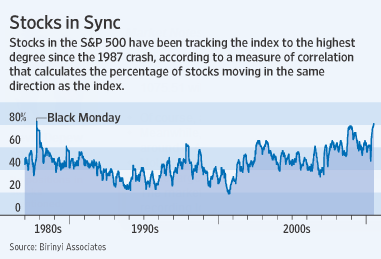
When I read Security Analysis, the investment bible by Graham and Dodd, I am transported to a past era when investment life was easier. You could focus your energies on finding companies trading at less than fair value. You focused on the balance sheet and the income statement. The economy was static. It grew a few percent a year and economic life was rather uneventful. There were panics and crashes, but these were usually confined to certain industries like railroads where there had been overexpansion. Most companies were immune to these economic disturbances.
Graham and Dodd could look at the Dollars on the balance sheet and feel confident that they would not be marginalized by the next round of quantitative easing. They didn’t have to worry about the fiscal sanity of their government. It was just taken for granted that the US government finances were solvent. Governments always enacted arbitrary laws, but no one had to worry about wholesale regulatory change every time congress was in session. Regulatory regimes changed gradually—if at all. Liabilities were what showed up on your balance sheet. An investor did not have to worry about wolf-packs of ambitious lawyers descending on every company in crisis and exacting an extra pound of flesh. Tax rates were constant enough to allow for long term economic planning.Prudent investors demanded a margin of safety before investing in a company. That margin of safety protected you from all of the above and still left plenty of room for upside. That is because most of the risks to a corporation were quantifiable. This let investors focus on their companies and ignore the newspapers. The macro world was largely irrelevant. You bought great companies at reasonable prices and waited until the share prices appreciated. World events simply didn’t matter. The business cycle only barely mattered. Buy cheap and let compounding work in your favor.

Now, investing seems to revolve around just one factor. What will the government do next? Which businesses will they clamp down on? Which will be subsidized? Who will get the next bailout? Will various tax subsidies be increased or eliminated? What new laws are in the mix? How can you anticipate all these changes?
There are no constants any longer. You cannot rely on anything. Everything seems perpetually in flux. The world economy is once again imploding. Will it be allowed to collapse? Unlikely. When will the next bailout be announced? What shape will it take? Who will the winners be? That really is the question that everyone demands an answer to. When is the next bailout? Bigger, Badder, More Corrupt—that’s our country’s new mantra. Which companies will lobby the right congressmen and be included? Which will be destroyed?
How do you invest in an environment like this? Say you look at a company. Do you want a business that’s economically sensitive—or one that has a strong and liquid balance sheet? Are you betting on them printing just a little money—or a full out Weimar style debasement? What’s the expected tax rate? It’s going up. That’s for sure. Will carbon taxes impact my businesses? What about changes in health care legislation? There are dozens of issues currently debated in congress. They all impact businesses.
Then there’s the whole wide world outside of the US. A generation ago, most businesses were regional. You could ignore what happened in China. Now China is the lynchpin of global economic growth. How can you decipher China? It’s monolithic. Will the Euro survive? Will it be debased or discarded as the component nations go their own separate way? Imagine the world’s largest economic bloc simply repudiating their currency? How do you invest for that? The whole investment climate is a daisy-chain of binary outcomes that are mutually exclusive. The middle ground seems vanquished.
These are the issues that I tango with daily. I invest in small businesses. Over the past decade, I’ve made a lot of money doing this. However, it continues to become more difficult. The rules change every day. A decade ago, I mostly ignored the macro—now I spend most of my time analyzing it. Small companies are illiquid and volatile. That has never bothered me before. Now I increasingly want more liquidity. I want the ability to react to the newest crisis. I am not a trader—now I have no choice. Every morning, I have to throw out all the old rules and start again. The macro events rule—businessmen are impotent.

I want to buy great businesses and put them away for years at a time. No longer can you trust that a dominant business will remain dominant. It won’t be a competitor that destroys the business. It will be an errant politician or a bad hedge on their Euro exposure. Volatility is destroying real businesses. Is every company now expected to hire whole trading desks to manage various exposures? How can you expect the most basic elements of a business to remain stable when the currency itself is increasingly detached from reality?
I have no problem navigating economic booms and collapses. That’s part of investing. What I strongly object to is the government increasingly inserting itself into the economy. You cannot manage an economy based on the applause meter of 24-hour news programs. You cannot manage an economy. Period. It is not debatable. Unfortunately, our government continues to corral the various market forces and lead them towards whatever myopic utopia politicians think will be needed for reelection. This creates economic anarchy. If you could run an economy based on erratic rules and crony capitalism, Argentina would be a world power. If you could print your way to prosperity, Zimbabwe would be a world banking hub. If you could command the economy to heed you, the USSR would still exist. I’m scared that world leaders have taken all the worst lessons of the last generation of economic thought and bundled them together into some sort of economic doomsday machine.

I apologize for this stream of consciousness. I’m frustrated. For my whole career, I believed that a great business with a strong return on capital would outperform all other asset classes. What if that isn’t true? For the past three years, only the macro has mattered. Going forward, what if the macro is ALL that matters? What if you have to rapidly jump from asset class to asset class as the rules change weekly? I hope this isn’t the case. However, it is time to consider that possibility.
In an age of increasing uncertainty, market multiples will collapse. Investors will demand an even larger margin of safety. Earnings will become increasingly volatile. Investors will focus more and more on the balance sheet. Unfortunately, most companies trade at many times book value. Some of the largest companies in the US have negative tangible book value. I expect to see market multiples continue to decline. Why would you risk your capital in uncertain times when you can just buy gold and ignore all the chaos around us? That’s really what I wrestle with the most. Gold will continue to go higher over time—if only because world governments seem determined to act foolish. Can you find companies that will outpace the price increase of gold? It will be difficult. The macro forces arrayed against business are just that extreme. You can no longer ignore the macro. The macro outweighs all else now.
Head over and read more of Kuppy's stuff at Adventures in Capitalism it is a fantastic blog.