
Friday, August 7, 2009


Interesting Comparison 1929 vs Now

I don't think this theory holds any water but it is interesting nevertheless.
More Unemployment Statistical Shenanigans
From NYT Blog:
While this blog posting is focusing on the rosy numbers, I'd like to take a moment to explain why these numbers are a complete fallacy. See the BLS decides to not count people that have given up trying to find a job, are working part time jobs to pay bills but are still looking for full time jobs, oh and the most important one: so long as you are continuing to get paid your unemployment benefits you are not counted in the BLS statistics. Guess what? We are rushing to reinstate more unemployment benefits at the cost of the taxpayer.
From AP
So one again the government manipulates the data and uses taxpayer funds to create the illusion of a better than expected jobs number.
The one thing that doesn’t deserve much excitement is what will probably garner many of the headlines: the drop in the unemployment rate. It happened only because more people stopped looking for work and were thus ineligible to be counted as officially unemployed. The share of adults with jobs actually fell: to 59.4 percent, from 59.5 percent.
While this blog posting is focusing on the rosy numbers, I'd like to take a moment to explain why these numbers are a complete fallacy. See the BLS decides to not count people that have given up trying to find a job, are working part time jobs to pay bills but are still looking for full time jobs, oh and the most important one: so long as you are continuing to get paid your unemployment benefits you are not counted in the BLS statistics. Guess what? We are rushing to reinstate more unemployment benefits at the cost of the taxpayer.
From AP
With the House planning to break this week for its summer recess and the Senate scheduled to depart at the end of next week, lawmakers took up the legislation with a sense of urgency.
"If we fail to act today, our people, our states and our economy will be harmed," said Rep. John Lewis, D-Ga.
Rep. John Dingell, D-Mich., said that without congressional action, "4.6 million people nationwide will not receive unemployment benefits in August and September."
The bill provides "such sums as may be necessary" for the federal unemployment insurance fund, a pool of money financed by payroll taxes. House aides estimated the actual transfer of money from the general treasury will be about $7.5 billion.
The fund is providing loans for the state unemployment benefit programs in 18 states that have become insolvent as the recession continues and the jobless rate approaches 10 percent.
Rep. Jim McDermott, D-Wash., said the 18 states already have loan balances exceeding $12 billion and more are expected to request assistance from the federal fund in the coming weeks.
He said about 9 million unemployment insurance recipients are now getting an extra $100 a month as a result of the stimulus package passed in February, and 3 million unemployed workers are receiving extended benefits.
States generally offer 26 weeks in unemployment benefits, averaging around $300 a week. Technically, the legislation does not add to the federal deficit because the states are obligated to repay the money they borrow.
So one again the government manipulates the data and uses taxpayer funds to create the illusion of a better than expected jobs number.
Grew's Too Good to be True Deals!
FRY's is selling a Samsung 50" plasma TV......
For $735
with Free shipping
Now everyone knows that aside from CRT (those giant glass tube TV's we all used to have) plasma sports the best contrast ratio and darkest blacks. Also this whole 720P vs 1080P there has yet to be a double blind test that shows anyone can tell the difference (much like those ridiculously overpriced Monster Cables).
So if you are in the market for a TV pull the trigger on this one.. you will thank me.
For $735
with Free shipping
Now everyone knows that aside from CRT (those giant glass tube TV's we all used to have) plasma sports the best contrast ratio and darkest blacks. Also this whole 720P vs 1080P there has yet to be a double blind test that shows anyone can tell the difference (much like those ridiculously overpriced Monster Cables).
So if you are in the market for a TV pull the trigger on this one.. you will thank me.
Inflation vs. Deflation: One man's thoughts
From the blog Up In The Crow's Nest where he discusses Inflation vs Deflation
He goes on to discuss how trying to fit our large, complex input/output economy into a universal label such as deflation or inflation is folly.
Head on over and give it a read. Each individual sector of the economy will experience their own inflationary or deflationary pressures due to each sector's unique attributes.
He concludes
The Inflationist: “The Fed’s money printing and other government spending must create inflation. And even if they don’t, the government will just up the ante until it does.”
The Deflationist: “But the output gap is huge! Until that closes, no one can raise prices and you certainly won’t see an inflationary wage spiral. Inflation just can’t happen until the output gap is much smaller.”
He goes on to discuss how trying to fit our large, complex input/output economy into a universal label such as deflation or inflation is folly.
Most commentators have therefore reconciled these two plausible arguments by concluding that we will get deflation for some time, then inflation. And, if the Fed gets it right, the inflation will be contained by various tightening maneuvers. So, inflation can’t happen here, right?
Probably wrong. Obviously no one will be surprised when the Fed moves too late to smother the seeds of inflation. But it is also possible that inflation happens before the overall economy is particularly healthy—in other words, stagflation. Here’s how.
Head on over and give it a read. Each individual sector of the economy will experience their own inflationary or deflationary pressures due to each sector's unique attributes.
He concludes
The point is that it may not take the wholesale recovery of the world economy to spark a faster-than-expected drawdown of stocks in certain commodity sectors and generate a “completely unexpected” surge in their price. When could this happen? If the economy has indeed hit bottom, and now grows very slowly, this would likely occur in 2010. If China’s recovery derails, as some commentators have recently suggested as a possibility, then all bets are off.
But once underway in the broader commodity sector, any employees with hard-to-replace skills will have the leverage to demand an increase in their wages to match the increase in the basic cost of living. Political leverage, such as Democrats still controlling the White House, could result in cost-of-living increases in various government benefits. The price/wage spiral will have begun—despite potentially millions of people still unemployed.
Morning Update

Well the reaction to the employment report (which is grossly manipulated by statistical assumptions) was positive and we have ourselves making new highs. The characteristic of the past number of trading sessions was to make new highs only to close back under prior highs. This is an example of buyers losing their power to move price higher. Today is too early to tell, but I am going to go out on a limb and say that we will probably end up with another day where we probe new highs only to close under prior highs, thus reconfirming my topping scenario.
If we are able to close into the Teens (1015+) as I said in previous market updates it will indicate to me that we are in the midst of a new up-leg. Most anything else and my topping scenario still holds water.
THe Employment Situation
Looks like the statistical "massaging" of the data would up with positive numbers
| Prior | Consensus | Range | Actual | |
|---|---|---|---|---|
| Nonfarm Payrolls | -467,000 | -300,000 | -375,000 to -190,000 | -247,000 |
| Unemployment Rate | 9.5% | 9.7% | 9.5% to 9.8% | 9.4% |
Thursday, August 6, 2009
More Government Run Companies Losing Money
From the AP
I dont' think I really need to comment as that last line sums it up perfectly
Fannie Mae plans to tap $11 billion in new government aid after posting another massive quarterly loss as the taxpayer bill from the housing market bust keeps growing.
"We are dependent on the continued support of Treasury in order to continue operating our business," Fannie Mae said in a Securities and Exchange Commission filing late Thursday.
I dont' think I really need to comment as that last line sums it up perfectly
Post office loses $2.4 billion this quarter
Bringing the grand total this year to.....
$4.7 Billion
From AP
Essentially the post office is a monopoly (I know Fedex and UPS but not really) They deliver everyone's mail. Its a simple monopoly and they can't make any money. What makes people think that the government can run an immensely complex system such as universal health care?
$4.7 Billion
From AP
WASHINGTON — The post office says it lost $2.4 billion from April through June.
That brings the year's losses so far to $4.7 billion. And the Postal Service expects to be $7 billion in the red when the fiscal year ends Sept. 30. The stark figures come from a decline in mail volume as people rely more on e-mail, plus a dip in advertising mail because of the recession.
In an effort to reduce costs, the agency has proposed closing several hundred local post offices, has asked Congress for permission to reduce mail delivery to five days a week, and has reduced hours at many offices.
Essentially the post office is a monopoly (I know Fedex and UPS but not really) They deliver everyone's mail. Its a simple monopoly and they can't make any money. What makes people think that the government can run an immensely complex system such as universal health care?
Late Afternoon Update

Well apparently sellers are willing to at least test the waters, with a move to take out 992-993. I find this very interesting as the employment report is coming out and usually everyone is paralyzed the afternoon preceding the news. In any other situation I would expect a break like this to extend down in a furious fashion; however, I'm still not willing to put my money into anything until I see how tomorrow morning pans out.
So long as any bounce holds 996 through the end of today it gives me that much more conviction in identifying a top.
The Sixth Extinction: A must read
The Sixth Extinction
Probably one of the most sobering accounts of our existence at large, and the implications of what were our actions will eventually take us.
There is a lot more to digest and I URGE everyone to read this article. I find myself lucky to have found 2 profoundly interesting articles within a span of a week (the other is here). It usually is months at a time before coming across stuff this good
Probably one of the most sobering accounts of our existence at large, and the implications of what were our actions will eventually take us.
If the 20th century was a time of expansion and growth for human population and economies, the 21st century will surely usher in a peak and decline in both. Today I talk about my "favorite" disaster, called The Sixth Extinction. Even in the age of politically correct environmentalism, most people could care less about the Earth's plant & animal species unless their decline bears directly and immediately on their own welfare. Accordingly, I will talk about some clear-cut examples where the health of the natural world adversely affects our future survival.
Before I do that, however, I want to touch on what I call, for lack of a better term, friedmanism.
I am referring to Tom Friedman, the influential Op/Ed columnist for the New York Times. I want to make it clear before I proceed that I am not launching a personal, ad hominem attack on Mr. Friedman. I'm sure he's a nice guy, sincere and well-meaning. However, he exemplifies an all-too-common way of thinking about the Big Planetary Issues that virtually guarantees that they will not get fixed.
....
But let's examine why, aside from being uninformed about physics, Friedman is optimistic. The short answer is: he's got to be! Friedman has to be a "blue skies" kind of guy if he wants to be a mover and shaker, and a fixture at the New York Times. The alternative is quite literally unthinkable.
....
Although we humans have been trashing the planet, and continue to trash the planet, Tom Friedman must cling to positive illusions about outcomes. But such unreflective optimism is not supported by reality. Unless a miracle occurs, there is little doubt about the species extinction outcome in the 21st century if we keep doing what we're doing.
But the power of positive illusions is that "people who remain optimistic in the face of insurmountable odds are healthier and finally more successful than those who have a more realistic attitude." Thus friedmanism is almost universal among high-functioning, successful human beings. It thus afflicts almost all of our society's leaders and elites, i.e. those people who are charged with keeping the growth machine running.
Any salesman will attest to the upside of maintaining positive illusions, but there is a downside as well—bankruptcy and destitution.
There is a lot more to digest and I URGE everyone to read this article. I find myself lucky to have found 2 profoundly interesting articles within a span of a week (the other is here). It usually is months at a time before coming across stuff this good
Big Picture Blog: Trade of the Century?
A Great Post over at the Big Picture from
We advanced our macroeconomic analysis last month to a level we feel confirms the future course of US monetary policy and the consequent likelihood of a highly inflationary outcome.
Make sure to head over there and read the rest. Fascinating stuff.
Paul Brodsky & Lee Quaintance run QB Partners, a private macro-oriented investment fund based in New York.
We advanced our macroeconomic analysis last month to a level we feel confirms the future course of US monetary policy and the consequent likelihood of a highly inflationary outcome.
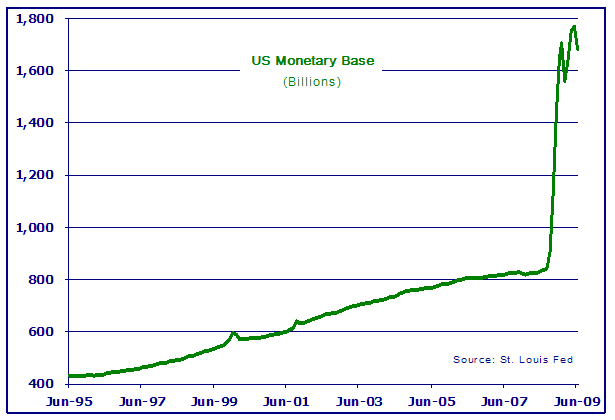
First, we tweaked the calculation of our Shadow Gold Price (SGP) from Federal Reserve Bank Liabilities divided by official gold holdings to Monetary Base (MB) divided by official gold holdings. (FRB Liabilities are bank assets while Monetary Base, plotted in the graph below, is a truer accounting of money - currency in circulation plus bank reserves held at the Fed.) The switch recognizes that borrowed reserves from the Fed included in FRB Liabilities are self-extinguishing, unlike additions to high-powered MB, which tend to remain permanent throughout all economic environments (and which may be further levered by the banking and shadow banking systems).
The change in our calculation produced a change in value of our Shadow Gold Price, yet we believe this new calculation is more robust and intellectually honest. As you can see from the graph below, the time series for the SGP mirrors the time series of the Monetary Base in the previous graph because the other variable in the equation (official gold holdings) has remained constant.

As the SGP implies, an ounce of gold would fetch almost $6,000 if we lived in a world characterized by disciplined money issuance. In effect, people and governments around the world would have been exchanging their Federal Reserve Notes for gold to the point that it would take 6000 bills to buy an ounce. The Shadow Gold Price solves for the price of an ounce of gold if the US dollar were still pegged to gold and its rise reflects the inflation of the Monetary Base. (Gold used to actually be the US Monetary Base prior to 1971, when the US and other governments abandoned the Bretton Woods Agreement that imposed monetary discipline on their money printing.)
Obviously this appears to be a crazy gold price within the context of the $900-plus price at which gold has been trading recently on global exchanges (though we do remember its rapid move from $35 to $880 the last time around). We are under no illusions that the price of Comex gold will rise to track what we see as its intrinsic value (not because it shouldn’t, but because we expect external market forces with great interests in protecting the sovereignty of fiat currencies to step in before that occurs, see “Potential Endgame – A Managed USD Devaluation” below).
Nevertheless, the SGP provides us with a baseline for inflation and absolute currency values. We also think the SGP is relevant because quantifying the magnitude of past purchasing power diminution provides us a framework for the relative scarcity of real capital assets versus financial assets and provides an intrinsic value target under which any market price for gold seems terribly cheap.
Manifestations
So far we have discussed past Monetary Base inflation and our attendant Shadow Gold Price, which indicates a wide disparity with gold’s public current market value. Consequently, we expect substantial increases in the prices of goods, services and certain investment assets. So why hasn’t it happened?
Make sure to head over there and read the rest. Fascinating stuff.
Subscribe to:
Posts (Atom)